Context
Governing rule of the framework: an access claim shall count only when the system that holds the access demonstrates it. Two components are documented here, the Entra ID sign-in component (V2) and the legacy file share governance component (V3), exclusively through the figures their repositories publish.
Every figure was produced by a captures.yml workflow on an ubuntu-24.04 GitHub runner. Each terminal figure is an xterm window on an Xvfb display running the commands shown, captured with ImageMagick; the printed output is retained beside it as a .log or .txt transcript. No figure is drawn by hand. A capture of an executed command is evidence in the same sense as a sign-in log; a diagram is not.
| Component | Implementation | Outside CI coverage |
|---|---|---|
| V2 | A C# (.NET 8) CLI that configures Debian hosts to sign in Microsoft Entra ID users through the SSSD idp provider |
A real tenant, the CLI's install command on a systemd host, its verify command, and the device code prompt at SSH login |
| V3 | IdentityIQ Legacy Filesystem Governance: a Java change planner, evidence library and IdentityIQ configuration for POSIX and ACL file shares | IdentityIQ itself and JBoss EAP; the configuration has not been imported into a running IdentityIQ instance |
Design rationale
Entra ID sign-in for Debian
Intent: only members of one Entra group shall log in; every login shall be an Entra sign-in subject to MFA and Conditional Access; a disabled account shall lose access at its next login. The CLI implements none of this directly. It renders, validates and installs SSSD configuration; SSSD 2.11.0 or later performs the sign-in through the OAuth 2.0 Device Authorization Grant. The design obligation is configuration that cannot drift into a weaker state.
 intent                                     setting in Figure 4
 ------                                     -------------------
 every login is an Entra sign in        --> id_provider = idp, auth_provider = idp
 only one group may log in              --> access_provider = simple
                                            simple_allow_groups = linux-admins
 a disabled account loses access        --> cache_credentials = false
 at its next login
 the same user has the same UID         --> idmap_range_min / max / size
 on every host
 the secret is readable by root only    --> -rw------- on the rendered file
register-appshall obtain its Graph token only from a Graph token environment variable oraz account get-access-token, and shall fail before any Graph request when neither is present.- Files holding the client secret shall be created with mode 0600.
- The validator shall not depend on the
sssctlrule set, which can lag new back ends. A non-zero exit status shall prevent theinstallcommand from starting SSSD on an invalid file. --hostadds three checks to the file check: installed SSSD version (2.11.0 or later), presence oflibsss_idp.so, and file mode. Debian 12 ships SSSD 2.8.2 and Debian 13 ships 2.10.1, neither with theidpprovider; theinstallcommand therefore pins only the SSSD packages from forky (2.13) on those releases. Without the pin, the check shall fail closed.
IdentityIQ governance of legacy file shares
Legacy file servers hold regulated records behind owner, group and mode bits, POSIX.1e ACLs and NFS export options that drift through manual change. The component places that access under IdentityIQ with an ordered, idempotent change plan, a separation of duties policy between finance and audit write access, and evidence that a revocation took effect on disk. Core logic resides in fsgov-core, a Java library with no IdentityIQ dependency, which is the part the runner can execute.
- Plan ordering: revocations first (ACL entries, then memberships), then group creation, ACL grants, explicit mask steps and membership grants. A request already satisfied by the snapshot shall yield no step.
- Command lines are a display form for reviewers only. The connector queues structured
#fsgov-plan v1steps and the host executor applies them; no command text is executed anywhere in the component. AccessDiffercompares IdentityIQ assertions with on-disk state per account and path pair. Evidence bundles are written in a canonical tab separated form with a SHA-256 digest, so identical inputs reproduce identical evidence.OrphanDetectorreports findings with no natural reviewer.- Revocation shall be proved by a fresh inventory, not inferred from the plan.
Results: Entra ID sign-in
Command line
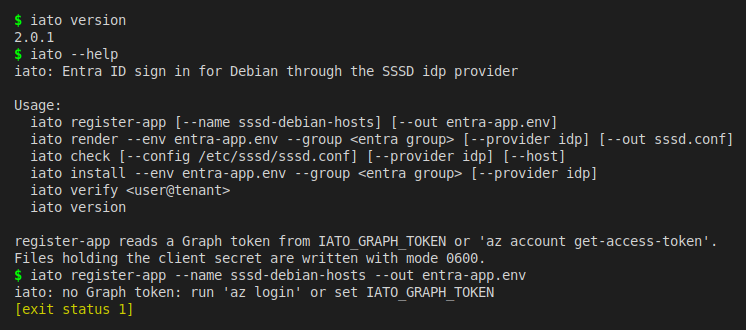
version command prints 2.0.1; --help lists six subcommands. register-app with no Graph token environment variable and no Azure CLI sign-in stops before any Graph request and exits with status 1.Release build
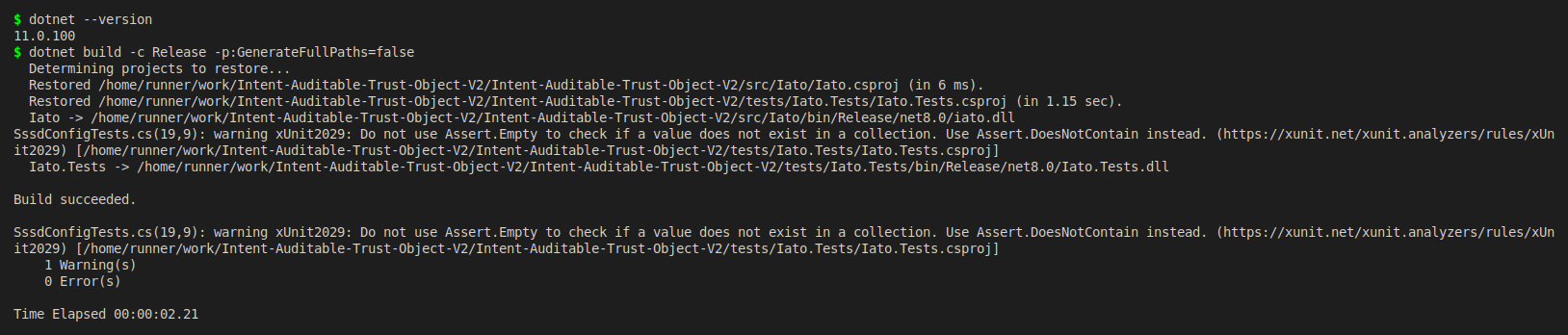
dotnet build -c Release restores and builds the CLI project and its test project for net8.0 with SDK 11.0.100: 0 errors, 1 warning, xUnit analyzer rule xUnit2029 at line 19 of SssdConfigTests.cs.Unit tests
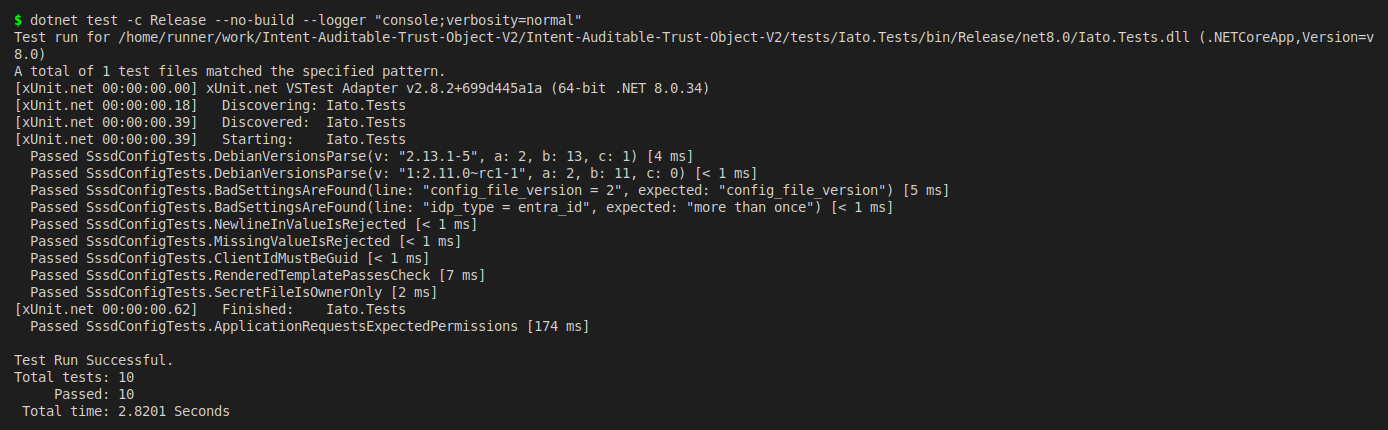
dotnet test -c Release with the normal console logger, each test listed by name. Total tests: 10; passed: 10.| Test | Control it protects |
|---|---|
DebianVersionsParse (two cases) |
The --host version gate parses Debian package versions, including an epoch and a release candidate |
BadSettingsAreFound (two cases) |
A key SSSD rejects, and a duplicate key, are caught |
NewlineInValueIsRejected |
A multi line value cannot inject a setting |
MissingValueIsRejected |
Rendering stops when a value is missing |
ClientIdMustBeGuid |
idp_client_id has the right shape |
RenderedTemplatePassesCheck |
The shipped template renders with no placeholders and no errors |
SecretFileIsOwnerOnly |
Output files are created with mode 0600 |
ApplicationRequestsExpectedPermissions |
The Graph request asks for exactly the two application roles and allows public client flows |
Rendered sssd.conf
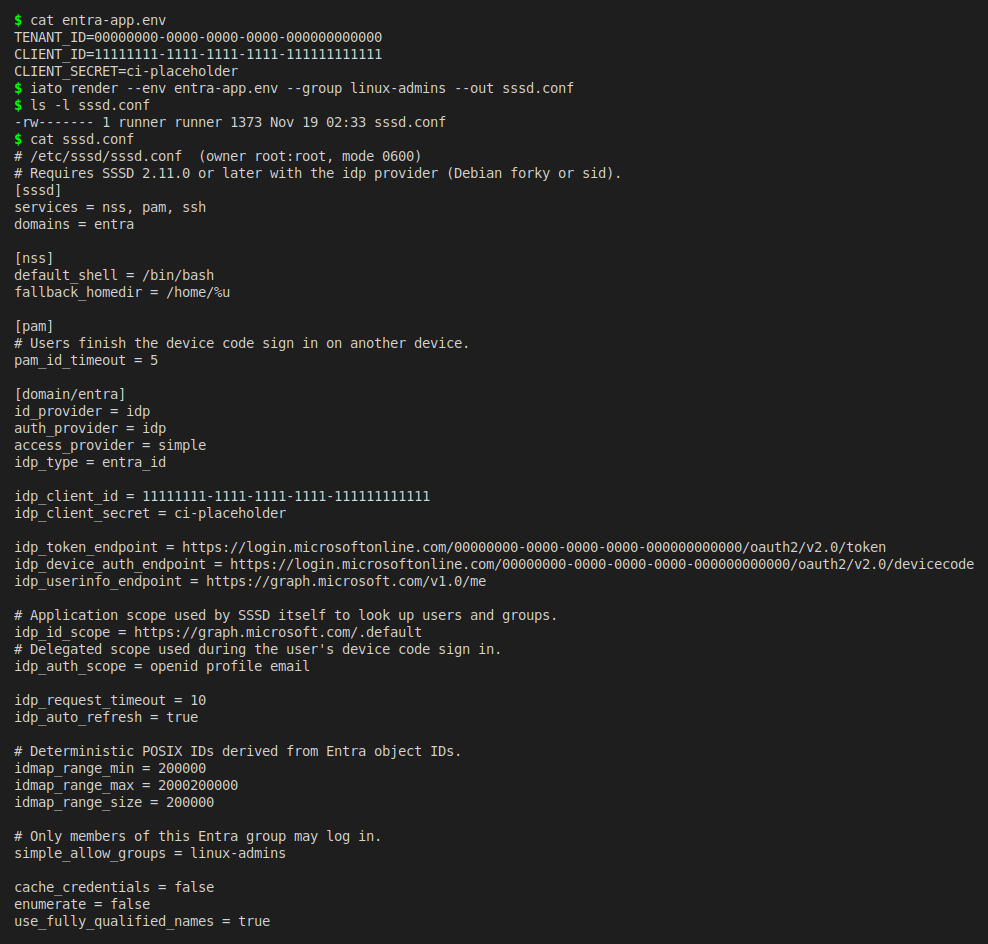
render command fills the embedded template from a placeholder entra-app.env and the group linux-admins; the file is created with mode 0600. [domain/entra] sets id_provider = idp, idp_type = entra_id, the tenant token and device authorization endpoints, the idmap range and cache_credentials = false.Identifiers in the figure are placeholders (00000000-... tenant, 11111111-... client, ci-placeholder secret). No figure contacts a tenant.
Configuration validation
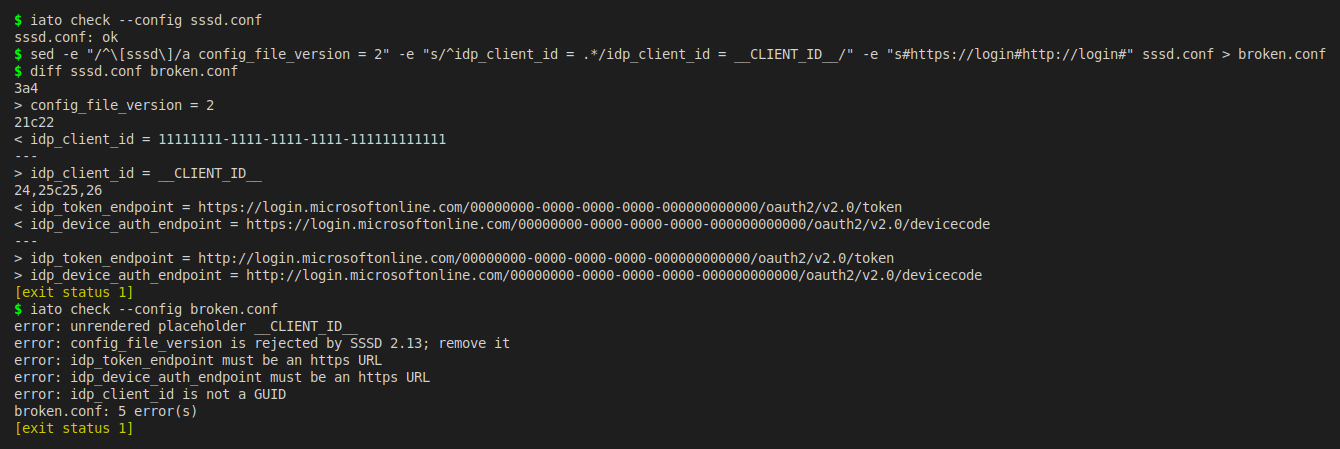
check command reports the rendered file as ok. A copy is mutated with sed: config_file_version added, idp_client_id replaced by a placeholder, two endpoints changed to http. check then reports 5 errors and exits with status 1.Every mutation in the diff is detected: an unrendered placeholder, a key rejected by SSSD 2.13, two non-https endpoints, and a client ID that is not a GUID.
Host check, Debian forky
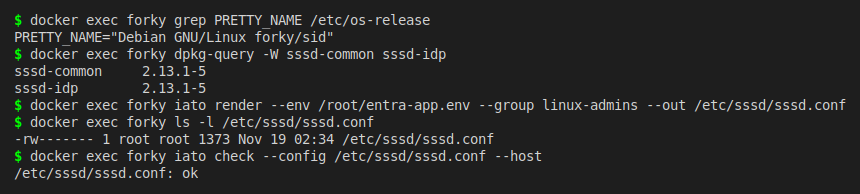
debian:forky container with sssd-common and sssd-idp 2.13.1-5: render writes /etc/sssd/sssd.conf as root with mode 0600, and check --host reports it as ok.The same command runs in ci.yml on every push; the passing state is continuously reproduced, not captured once.
Host check, Debian 13
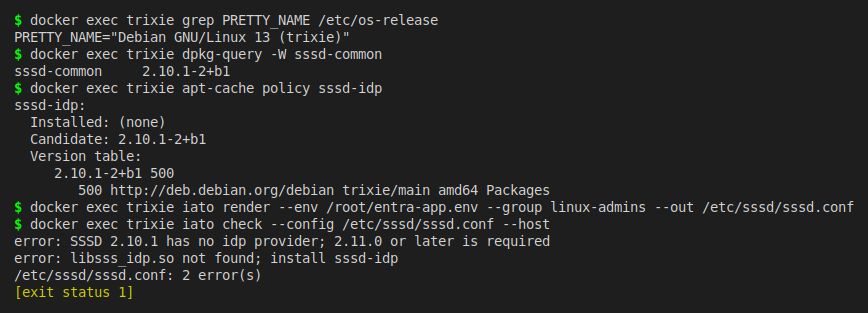
debian:trixie container, sssd-common 2.10.1-2+b1, no sssd-idp. check --host reports that SSSD 2.10.1 has no idp provider and that libsss_idp.so is missing, and exits with status 1, as specified.Results: file share governance
Build and tests
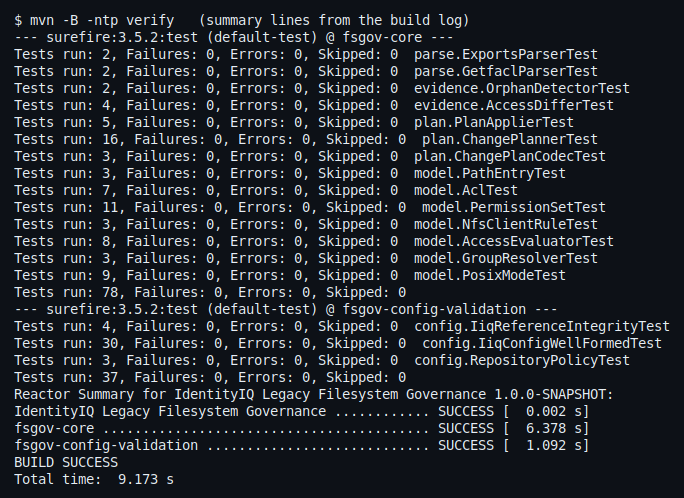
mvn -B -ntp verify: 78 tests in 14 classes of fsgov-core and 37 tests in 3 classes of fsgov-config-validation, no failures, errors or skips, BUILD SUCCESS.| Module | Test classes | Tests | Failures | Errors | Skipped |
|---|---|---|---|---|---|
fsgov-core |
14 | 78 | 0 | 0 | 0 |
fsgov-config-validation |
3 | 37 | 0 | 0 | 0 |
| Total | 17 | 115 | 0 | 0 | 0 |
The 37 configuration tests assert that every artifact parses and declares the sailpoint.dtd DOCTYPE, that every object reference and rule name resolves, that every %%TOKEN%% has a value, and that the repository contains no script sources.
Coverage

fsgov-core: 97 percent instruction coverage and 88 percent branch coverage over 48 classes in four packages.JaCoCo 0.8.12 reports 171 of 6,100 instructions and 72 of 648 branches missed. The build enforces a floor of 85 percent line coverage and 70 percent branch coverage; coverage is a gate, not a statistic.
POSIX ACL fixture
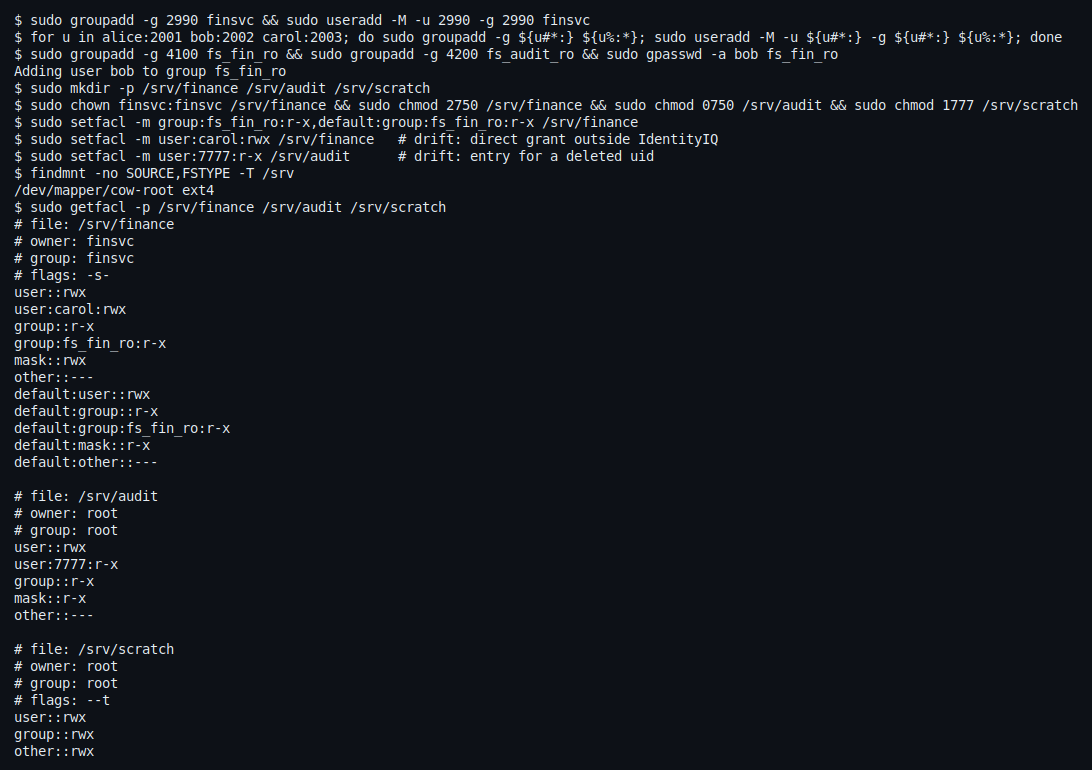
/srv/finance, /srv/audit and /srv/scratch, two drift entries (user:carol:rwx and user:7777:r-x), and the resulting getfacl -p output.All subsequent figures execute against a real file system, not a mock. Drift entries: a direct rwx grant to carol on the finance share outside IdentityIQ, and an entry on the audit share for uid 7777, which maps to no account. The exports file is parsed but not loaded into the kernel.
Inventory and effective access
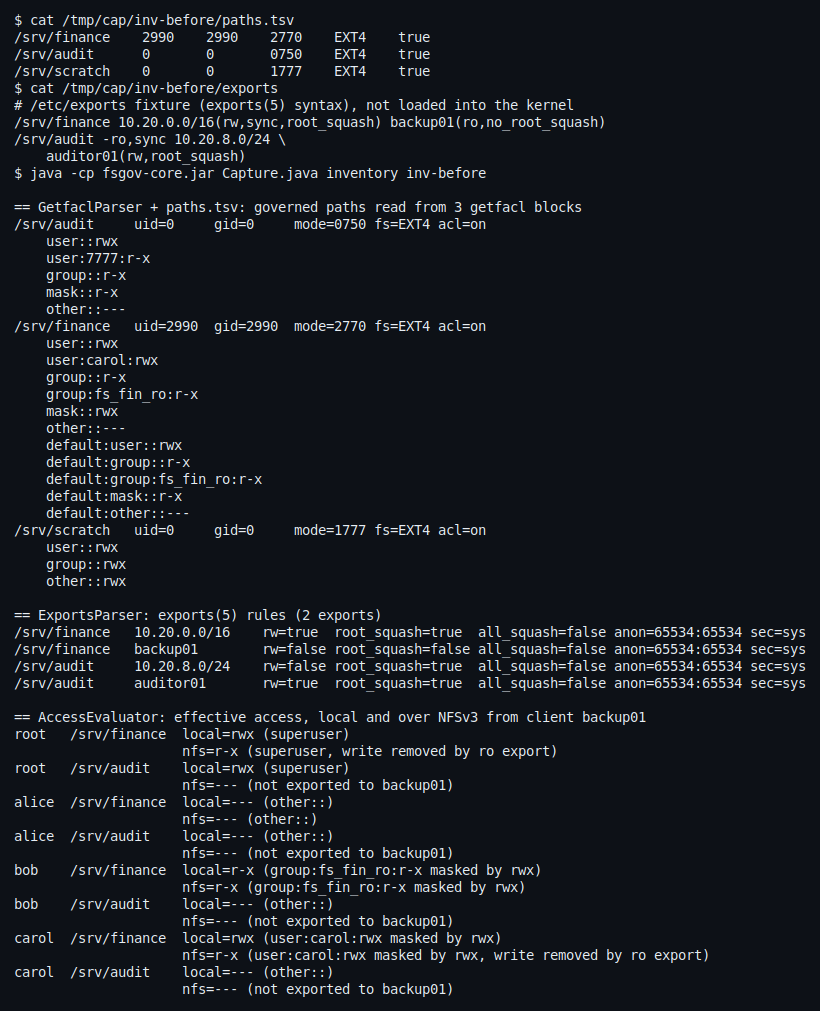
GetfaclParser and ExportsParser, and effective access from AccessEvaluator, locally and from NFSv3 client backup01, where the ro export removes write. The mode column is taken from stat.carol holds rwx on /srv/finance locally through user:carol:rwx masked by rwx, and r-x from backup01 under the read-only export. The mode reads 2770 rather than the 2750 that was set: with an ACL present, the group bits reflect the mask.
Change plan
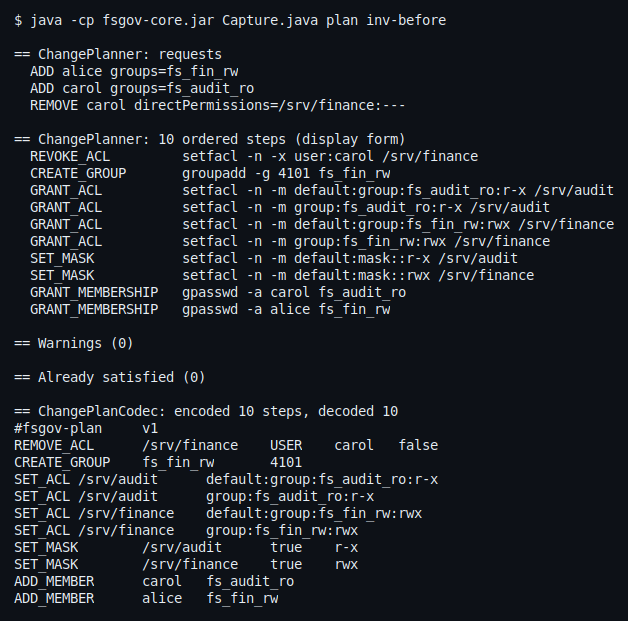
ChangePlanner output for three requests (grant fs_fin_rw to alice, grant fs_audit_ro to carol, remove carol's direct entry on /srv/finance): ten steps, revocation first, no warnings, and a ChangePlanCodec round trip of all ten steps.Evidence before remediation
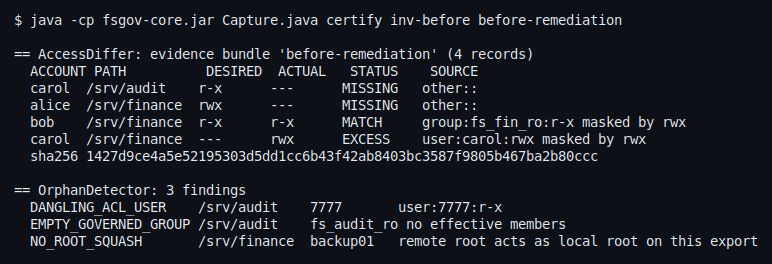
MISSING records, one MATCH and one EXCESS (carol's direct rwx on /srv/finance), with three hygiene findings: a dangling ACL entry for uid 7777, an empty governed group and a no_root_squash export.The EXCESS record becomes a review item. The OrphanDetector findings are an entry for a uid with no account, a governed group with no effective members, and an export under which remote root acts as local root.
Plan applied
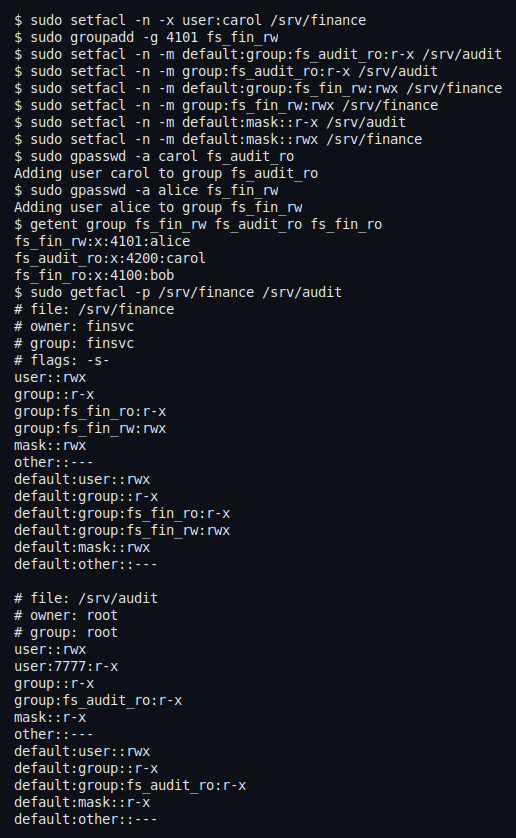
getent group and getfacl -p showing the new group entries and default ACLs and no entry for carol on /srv/finance.The figure is the read-back, not the request: fs_fin_rw contains alice, fs_audit_ro contains carol, and /srv/finance no longer lists user:carol.
Evidence after remediation
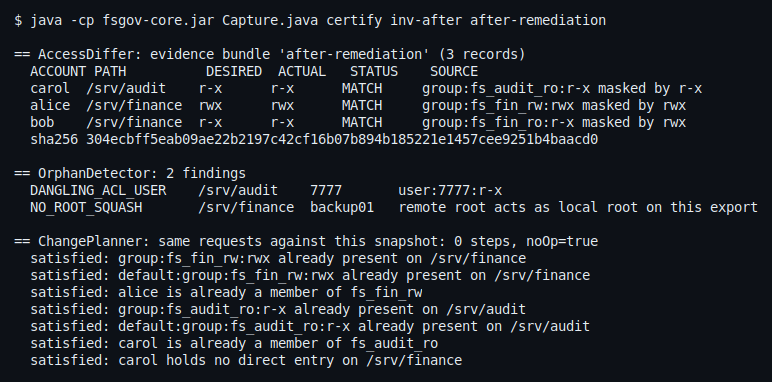
MATCH records and the two findings outside the requests. Replanning the same requests yields zero steps and reports seven already satisfied conditions.Observations
register-appfails before transmission, so a missing credential cannot produce a partially created app registration.- The single build warning is an analyzer style rule in the test project (
Assert.DoesNotContainin place ofAssert.Empty), not a defect in the CLI, and is reported rather than suppressed. - No tenant exists on the runner;
ApplicationRequestsExpectedPermissionstherefore verifies the Graph request body in a unit test in place of a capture against Entra ID. - The Debian 13 failure (Figure 7) is the condition the forky pin exists to prevent; the check fails closed instead of starting a service that cannot enforce the intent.
- The 37 configuration tests are well-formedness and consistency checks, not validation against
sailpoint.dtd, which is not public. - Remediation closes the loop: the revocation is proved by a new inventory (Figure 15), not inferred from the plan (Figure 12). The remaining findings, the dangling uid 7777 entry and the
no_root_squashexport, were outside the requests and continue to be reported. The empty replan is the idempotency property on which the connector relies. - Every control is expressed as a check that can fail: the configuration check exits 1, and the replan is empty or it is not.
Limitations
- Entra ID sign-in: the CLI's
register-appcommand against a real tenant,installon a systemd host,verify, and the device code prompt thatpam_sssprints at SSH login are not captured, because CI has neither a tenant nor a systemd host. CI does not cover Debian 12, Debian 13 or sid hosts. - The client secret is the only credential type the
idpprovider currently supports. A certificate credential is planned and not implemented. - File share governance: no figure shows IdentityIQ or JBoss EAP; both require a licensed or running server that the capture workflow lacks. The IdentityIQ artifacts have not been validated against
sailpoint.dtdor imported into a running IdentityIQ instance, the adapter has not been compiled againstidentityiq.jarin CI, and the JBoss CLI scripts have not been run against a server. - The host executor is not part of the repository; the workflow substitutes for it on a runner that is discarded afterwards.
- The IdentityIQ configuration is a reviewed starting point. It shall be imported and tested in a sandbox before promotion to any higher environment.
Source:
 Entra ID sign in for Debian with SSSDConfigures Debian hosts to authenticate Microsoft Entra ID users through the SSSD idp provider.github.com
 Identity governance for legacy Linux file sharesBrings POSIX permissions, ACLs and NFSv3 exports on legacy file servers under request, approval and certification.github.com